BusinessTimes
SINGAPORE: Singapore's United Overseas Bank (UOB) said yesterday its fund management arm has formed an alliance with a unit of India's UTI Asset Management to jointly launch and distribute mutual funds.
"The first initiative of the alliance is an equity fund that both parties have jointly developed," UOB Asset Management (UOBAM) said in a statement.
"The features of the fund will be announced at a later date."
UOBAM manages about S$13.5 billion (S$1 = RM2.44) in assets and has business operations in Singapore, Brunei, Japan, Malaysia, Taiwan and Thailand.
Its partner UTI International (Singapore) is a joint venture involving India's largest mutual fund company UTI, Shinsei Investments and another company.
UTI manages around US$15 billion (US$1 = RM3.51) and its funds are distributed in 450 of India's 620 districts, UOBAM said. - Reuters
Disclaimer: Reading materials in this site are obtained from its respective website and it is for information purposes only. It is not Malaysia Unit Trusts - administrator view and it is not to be used against Malaysia Unit Trusts - administrator.
TheEdge
KUALA LUMPUR: Ethics and a forward-looking approach are key factors for investors to consider when selecting a fund manager, industry experts said.
Securities Industry Development Corp (SIDC) chief executive officer John Zinkin said investors should look at the integrity of the fund manager’s organisation — for example, how the fund manager was rewarded.
“The investor should also assess whether the fund manager has an understanding of the investor’s risk appetite, that they understand what you want in your time horizon.
“Do you want your fund manager to be engaged or passive? There are a lot of fund managers who are passive investors, they don’t go in with that engagement,” Zinkin said.
Speaking to The Edge Financial Daily, he said investors should also be clear on what they wanted out of their fund managers. “Do you just want to take your returns, or do you think through the fund manager, have an interest in the way the business (you are investing in) is being run?” he added.
Meanwhile, Zinkin said the size of Malaysia’s capital market was not enough to justify the inadequate level of corporate governance exercised.
“The governance problem is hurting the Malaysian equity market as a whole. Fund managers look at Malaysia and say it’s got a governance problem, but the market is not big enough to take the risk on.
“China’s got a much bigger governance problem, but the opportunities there are so big that people will live with that. There’s not enough going on in the market to make people want to come in here, if there’s also a slight question mark about governance.”
Watson Wyatt Worldwide practice leader (investment consulting) Puah Ser Sze added that the typical practice of looking at fund managers’ past performance was not sufficient to select the right fund manager.She said the investor should be in tune with the fund manager’s skill cycle, due to the amount of “noise” in the market.
“You have to base it on qualitative data. The criteria you should look at is the business, the people, and the investment process. You have to have good people because information gets arbitraged quickly in today’s seamless market, and with regard to the investment process, does the fund manager’s organisation have a competitive advantage?” Ser Sze said.
She added investors should be cautious of products offered by the fund manager, as part of the cause of the subprime crisis had been the over-incentivisation of low-quality products.
Meanwhile, Mercer (Singapore) Pte Ltd senior consultant Antony C Cherian said: “A skilled, active manager can add value to your investments. The challenge is to find that skilled, active manager, and this is where the research is required.”
He agreed investors should emphasize a forward-looking approach to identifying a fund manager, while criteria fund managers should have included business management skills, idea generation, portfolio construction and implementation.
He added that while Malaysian fund managers were largely on par with foreign fund managers in managing Malaysian equities, foreign managers were more experienced in managing global equities, and hence there was a need for Malaysian investors to include more asset classes to their portfolio, instead of just Malaysian equities and bonds.
Disclaimer: Reading materials in this site are obtained from its respective website and it is for information purposes only.
PublicMutual
In the current environment of global economic turbulence, investors may choose to invest in a more resilient portfolio comprising large cap Shariah-compliant companies listed on Bursa Securities.
Such a fund aims to achieve the objective of medium- to long-term capital growth through investments in a diversified portfolio of Shariah-compliant equity securities that offer good prospects. Public Islamic Select Enterprises Fund (PISEF) will invest 75% to 90% of its Net Asset Value (NAV) in the 50 largest Shariah-compliant stocks in terms of market capitalisation in the domestic market with the balance of its NAV invested in sukuk. Given the above investment strategy and objective, the fund is suitable for medium- to long-term investors with aggressive risk-reward temperaments.
Advantages of Investing in PISEF
By focusing on the 50 largest Shariah-compliant companies listed on Bursa Securities, the fund offers investors the opportunity to invest in companies that have established track records with relatively large market capitalisations. As at 11 August 2008, the 50 largest Shariah-compliant stocks have a combined market capitalisation of RM398 billion, which accounts for about 80% of the total market capitalisation of the FTSE Bursa Malaysia Emas Shariah (FBMS) Index. The remaining Shariah-compliant stocks account for the balance of 20% of the FBMS Index's market cap.
In general, the prospects for large corporations are expected to remain resilient as they are better positioned to withstand more challenging economic conditions due to their economies of scale, stronger financial resources, size and established market shares.
Larger companies are able to generate greater economies of scale as their costs of production and operating expenses are spread over a larger volume of units produced and sold. In addition, many large cap Shariah-compliant companies in Malaysia are well established companies with linkages to government agencies or established business groups. Consequently, these features enable large cap Shariah-compliant companies to obtain better access to financing and more competitive financing terms from the capital markets.
Given that foreign and local institutional investors generally focus on large and more liquid Shariah-compliant stocks, large cap Shariah-compliant stocks are expected to continue to figure prominently in their investment portfolios over the medium- to long-term. The earnings and share prices of large cap companies are also poised to recover ahead of their smaller counterparts in an economic up cycle.
Outlook for the Malaysian Economy
Despite uncertainties on the external front, Malaysia's gross domestic product (GDP) growth is projected at 5.0% in 2008. Our forecast assumes a moderation in private consumption growth to 6.5% in 2008 compared to 10.8% in 2007 while public spending is envisaged to grow at a sustained pace of 6% in 2008 versus 6.6% in 2007. Thus, sustained growth in private consumption and public spending will mitigate the anticipated slowdown in external demand for Malaysia's major export markets namely the U.S., Europe and Japan.
From the supply perspective, the Malaysian economy continues to be spearheaded by a resilient services sector. The services sector, which includes real estate, retail and financial services and accounts for 54% of the GDP, is expected to grow by 7.7% in 2008 compared to 9.7% registered in 2007.
In the mining sector, which comprises largely the oil and gas industry, growth is anticipated to gain pace to 6.0% in 2008 from 3.3% 2007 as the oil & gas industry has benefited from an environment of elevated crude oil prices.
The agricultural sector is projected to register a growth of 3.4% in 2008 compared to 2.2% in 2007 on the back of resilient demand for agricultural commodities. Meanwhile, growth in the construction sector is envisaged to rise to 5.5% in 2008 from 4.6% in 2007, supported by the rollout of the 9th Malaysia Plan.
The Benchmark's Track Record
An appropriate benchmark to be used to evaluate the performance of a Shariah-based Islamic fund such as PISEF is the FBMS Index as its component stocks comprise all Shariah-compliant stocks listed on the Main Board of Bursa Malaysia. This benchmark index has achieved commendable total returns of 25.22% (i.e. annualised growth of 7.8%) and 48.62% (i.e. annualised growth of 8.2%) respectively for the 3 and 5 year periods up to 8 August 2008.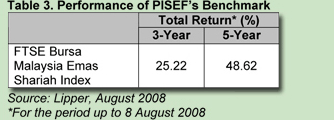
Reading materials in this site are obtained from its respective website and it is for information purposes only.
TheStar
Product provides capital guarantee and returns higher than fixed deposit rates
KUALA LUMPUR: Malaysian Assurance Alliance Bhd (MAA Assurance), in tandem with rising global inflation and volatile equity markets, has launched a structured investment product that provides capital guarantee and returns higher than fixed deposit rates.
The product, Master Capital Guaranteed Plan Swing 6, is syariah compliant and focuses on three themes, namely China and Hong Kong, mining and steel, as well as oil and gas. Each theme will invest in two stocks.
Vice president for life business development services division Y.C. Chan said the product was ideal and suitable in light of the current economic situation coupled with low fixed deposit rates.
“We are targeting fixed depositors as well as those hoping to make some potentially higher returns in this challenging economic environment.
“Policyholders can expect to rake in an average of about 12% returns per year for this plan.
“We are also hoping to achieve gross premiums of at least RM50mil in the first two months of its launch. The product was launched last Friday,’’ he said during an interview.
According to Chan, the company was optimistic of the product as it allowed policyholders to obtain potentially higher returns from investment and, at the same time, would provide capital guarantee at the end of the fourth policy year.
He attributed the investment in the China and Hong Kong markets to the former’s robust economic growth and the latter’s ability to tap into the mainland’s growth and benefit from buoyant trade, services, retail and property sales.
China’s economy was expected to grow at 8%-10% per annum over the next three years spurred by a strong domestic economy, infrastructure spending, population and income growth, he noted.
Chan added the mining and steel as well as the oil and gas sectors had good potential.
“The demand for commodities and steel is seen outstripping supply, with robust demand coming from Asia, especially China and India.
“The crude oil market is facing tight supply and geopolitical tensions and its demand remains relatively unresponsive to higher prices,” he added.
A minimum premium of RM10,000 is needed for this plan and, apart from capital guarantee, it also provides insurance coverage.
Death benefit is provided for the first RM2mil premium (per insured), thereafter, any amount above this figure would not be covered for insurance protection.
He said a policyholder could, if hewished, withdraw his capital guaranteed benefit at the fourth policy year and terminate the policy, or maintain and continue by switching the benefit into other MAA investment-linked funds without any charge.
Disclaimer: Reading materials in this site are obtained from its respective website and it is for information purposes only.
TheEdge
There has been a lot going on in global financial markets. With volatility likely to continue, and general consensus of a slowdown in major economies, the question most frequently asked is: Where and what should I invest in next? Given the uncertainties and increasing challenges, investors are exploring various investment options to stay ahead of the curve, and opportunities to improve long-term returns.
This article will cover some of these investment choices known as alternative investments, which complement traditional investing and have been attracting a growing interest from institutional, high net worth individuals as well as retail investors.
Alternative investments
Investments in our market comprise mainly equity, bonds and property. These are traditional investment vehicles. Over time, with innovation and increased understanding of the markets, other alternatives have started gaining popularity.
Many alternative investments with minimal correlation to traditional benchmarks have proven to be resilient in volatile markets and uncertain economic conditions. This formula has worked well supporting the investment rule of thumb — portfolio diversification — and increasing resilience against risks.
An understanding of alternative investments may be helpful in supporting more informed investment decisions, for exposures to other than just equity and bond markets.
Alternative investments include familiar products such as private equity, real estate and structured products; whilst examples of more sophisticated options include managed futures and hedge funds.
In contrast to traditional investments, alternative investments seek absolute performance and depend on advisers’ skills for performance. They may use leverage and have historically low to moderate correlation with market indices. Typically, it is not as easy to liquidate such investments as there may be fixed periods ranging from monthly to yearly, and may include possible lock-up periods. Charges may generally be higher and in the form of performance fees.
Traditional investments, on the other hand, would seek relative performance where returns depend primarily on market performance. They have historically high correlation with market indices. These forms of investments generally do not employ leverage, offer daily liquidity and charge fixed management fee on assets under management.
Why invest in alternative investments?
Alternative investments offer opportunities to qualified investors to diversify their portfolios by combining alternative strategies with traditional holdings, aimed at generating steady returns and preserving wealth through fluctuating market conditions.
Over the years, while the risk-adjusted returns in the stock and bond markets have become less, modern investment instruments such as alternative investments have helped realise consistent returns over time, as they tend to move in opposite directions to traditional strategies.
Alternative investments have helped preserve opportunities for positive returns even during times when stocks and bonds under perform.
Types of alternative investment
1. Private equity
Private equities are privately negotiated deals that are invested in mostly non-public companies that may be in different business phases or categories. This would include start-ups, companies in the development stage or expanding, a buyout situation, perhaps restructuring. Investments could be in form of venture capital (VC); leveraged buyouts (LBO); mezzanine or distressed debt.
Private equity managers could be stand-alone or fully integrated organisations that may take an active role in a target company’s management with the objective of creating value during the period of investment, and to exit profitably.
2. Real-estate investment
This is probably one of the most commonly known forms of alternative investing. Real-estate investment would have an internal rate of return objective although there is no guarantee of the return objectives being met. Leverage could range from 0-75% and the investment has low correlation with market indices.
There is less volatility compared to equities and fixed income as investments are in physical assets, though investments would be relatively illiquid. Real-estate investment could offer an advantage in the form of potential inflation hedge.
Real-estate investment can be public and debt-based like commercial mortgage-backed securities (CMSB) or public and equity-based like real-estate investment trust (REIT) stocks or real-estate mutual funds. Other forms of investment include private and debt-based like mezzanine debt or senior loans or private equity like open and closed-end funds.
Investors should note that commercial real estate can offer portfolio diversification as historically it has low correlation with other asset classes and has provided steady returns over the long term. It has proven performance versus other investments. It is different from family homes and there is risk/return trade-offs in various real-estate investments.
3. Structured products
Of late, structured products have become popular in the market as it can offer the security of principal protection with the opportunity of further income upside. Structured products can be performance-linked, leveraged/arbitrage products and principal protected.
Performance-linked products may be linked to the performance of a basket of assets such as stocks, bonds or hedge funds; or to indices like Morgan Stanley Capital International (MSCI), FTSE or S&P Indices. They are usually illiquid and have no leverage.
Principal-protected products offer capital assurance with potential upside from returns linked to performance of predetermined assets. Principal protection is only valid if the investment is held till maturity.
Leveraged/arbitrage products are investment products that generate returns based on the spread between assets and financing costs. They normally have limited liquidity, with potential for high returns, which comes with association of high risk.
Structured products can be customised to fit the unique requirements of individual investors and can offer potentially higher yields than of market norms if certain scenarios materialise. The underlying structure could be in forms of various exposures to diversified market sectors — they could be offered in one packaged security or maybe repackaged as credit-enhanced/principal-protected products to be managed actively with the aim of improving the risk/return profile of the investment.
4. Managed futures
Managed futures are essentially an alternative investment strategy that offers access to global futures market via professional money managers called commodity trading advisers (CTAs).
CTAs use trading strategies and money-management techniques to attempt to achieve profits and control risks. They trade in global markets including futures, options and forwards on traditional commodities like gold, crude oil, soybean and crude palm oil. They also trade in financial instruments such as the US Treasury Bond, British Long Gilt and NYSE Stock Index as well as currencies, which include but are not limited to the euro, Japanese yen, Czech kroner and Thai baht.
As in any other forms of investment, there are risks involved. Due to the use of leverage, a small change in market price of a futures contract can produce major gains or losses for a managed futures contract.
Nevertheless, from January 1994 till June 2008, managed futures generated an average rate of return of 7.25% compared with the S&P 500 of 8.65%, Nasdaq of 12.6%, Global Stocks of 7.49% and Global Bonds of 7.83% (Credit Suisse Tremont Hedge Fund Index LLC, Lipper as at July 2008).
Given the sophistication of this investment class, fees are higher than that of traditional funds.
5. Hedge funds
Hedge funds aim to make absolute returns regardless of market conditions. They offer greater flexibility than traditional investment managers and can go long and short on stocks. Use of derivatives and leverage is allowed and normally hedge funds impose a higher minimum investment amount. Performance fees are charged based on returns generated by the managers.
Hedge funds do have liquidity restrictions and are moderately regulated with limits on capacity.
Here are several facts about hedge funds.
i) In the early 90s, the hedge fund industry was dominated by high-risk, aggressive macro players. It has since evolved significantly in terms of AUM as well as sophistication, and in 2007, there were over 10,000 hedge funds with many more diversified strategies. Hedge funds do not apply the same investment strategies as other funds.
ii) Hedge funds are not only for bear markets as they seek low or negative correlation to traditional long-term investing.
iii) Hedge funds do not always lack transparency. Whilst skill-based investing may be less transparent than traditional investing, some hedge fund managers make transparency their selling point.
Generally, hedge funds offer opportunity to improve portfolio efficiency with enhanced returns while potentially reducing risk. It also advocates diversification with low correlation to existing asset classes and the chance to participate in investments managed by top-rated hedge fund managers, using different strategies and employing a wide range of instruments.
A fund of hedge funds is a multi-manager hedge fund that has dedicated and expert teams of managers. The assembling funds of hedge funds create a significant advantage over private investors as it offers the opportunity of exposure to a diverse set of strategies in a single investment.
Multi-manager funds have access to the best managers, who often close quickly and limit allocations to long-term clients who buy and hold. Very importantly, fund of hedge funds offers diversification, as it minimises risks by combining funds and strategies.
Minimum investments are lower than single-strategy funds, hence reducing the strain of high-value investing. Transparency is not an issue as they are able to obtain and interpret complex information, which could be a challenge to private investors.
In a fund of hedge funds, strict due-diligence processes facilitate identification of quality managers, while continuous monitoring and reviews are enforced.
Portfolio construction and readjustments of positions are made throughout the life of the portfolio. These efforts are resource intensive and could not possibly be conducted by a private investor.
It is important for investors to read, research and understand the features, liabilities and benefits offered by alternative investments such as private equity, real estate, structured funds, managed futures and hedge funds. A well-diversified portfolio, which incorporates some form of alternative investment, could help increase returns and lower portfolio volatility overall.
Aisyah Lam is the head for wealth management products, Citibank Berhad
Disclaimer: Reading materials in this site are obtained from its respective website and it is for information purposes only.
TheStar
KUALA LUMPUR: AmInvestment Bank Bhd is planning to capitalise on the global commodity boom with its new fund called AmCommodities Extra.
Managing director Kok Tuck Cheong said the long-term outlook for commodities remained positive due to a mismatch of supply and demand, which had raised commodity prices.
“Commodities have low correlation to equities and bonds, and therefore provide investors another alternative class of investment to enhance their portfolio as well as preserve their wealth against inflation,” he said at the launch of the fund yesterday.
“It has been observed that commodities have consistently outperformed inflation and commodity prices are rising faster than inflation rate.”
On the high volatility that the market experienced lately, chief investment officer (fixed income) Yvonne Phe said the fund had a “revolver strategy” feature, which would reduce exposure of underlying assets during vicious swing and increase exposure when volatility subsided.
AmCommodities Extra invests 90% in fixed income instruments and 10% in structured derivative instruments with exposure to potential upside of commodities theme. These structured derivatives provide 75% exposure in Rogers International Commodity Index (RICI), an index managed by Jim Rogers, a well-known commodities guru, while the remaining underlying assets consist of commodity-related equity indexes in Australia, Brazil and China.
However, this fund does not include crude palm oil (CPO) because of its thin trading volume. Chief executive officer Datin Maznah Mahbob said the fund would emphasis on liquidity but she might consider CPO in the future if the liquidity improved.
Meanwhile, director (retail funds) Ng Chze How said this fund provided an opportunity for portfolio diversification, as most of Malaysian investments were in bonds, equities and cash.
“For investors who can assume medium to high risk, they should consider this class of investment,” he said.
As at June 30, RICI constituted 44% energy, 34.9% agriculture and livestock, and 21.1% precious metals.
Ng said AmInvestment expected AmCommodities Extra to be fully subscribed in six to 12 months.
Disclaimer: Reading materials in this site are obtained from its respective website and it is for information purposes only.
Continue Reading >>>
PublicMutual
Public Bank’s wholly-owned subsidiary, Public Mutual declares distributions for four of its funds. The total gross distributions declared for the financial year ended 31 July 2008 are as follows:
Public Growth Fund: 10.00 sen
Public Bond Fund: 5.00 sen
Public Islamic Opportunities Fund: 4.00 sen
Public Islamic Select Bond Fund: 1.50 sen
Public Mutual’s Chairman Tan Sri Dato’ Sri Dr. Teh Hong Piow said Public Growth Fund and Public Bond Fund which are the winners of The Morningstar 2007 Fund Awards (Malaysia), have generated five-year returns of 85.14% and 24.41% respectively for the period ended 11 July 2008, according to The Edge-Lipper Fund Table dated 21 July 2008. Public Bond Fund is also the winner of The Edge-Lipper Malaysia Fund Awards 2008.
Meanwhile, Public Islamic Opportunities Fund which was ranked No. 1 for its three-year returns has generated a return of 59.70% for the same period in its category. Public Islamic Opportunities Fund was launched in 2005 while Public Islamic Select Bond Fund was launched last year.
Public Mutual is the largest private unit trust company in Malaysia, and it manages 64 funds for more than 1,800,000 accountholders. As at 30 May 2008, the total fund size managed by the company was RM28.4 billion.
Disclaimer: Reading materials in this site are obtained from its respective website and it is for information purposes only.
BusinessTimes
Although Malaysia market valuations are very reasonable now, the outlook remains uncertain given the political uncertainties, says a Hong Kong fund manager
FOREIGN fund managers are continuing to cut their exposure in Malaysia, with most saying that while the economic fundamentals remain relatively sound, the political outlook is a big concern.
"Malaysia actually remains a pretty attractive market, but the recent political uncertainties make people like us hesitant to invest," said a fund manager from Hong Kong whose company manages some US$5 billion (RM16 billion) in the region, of which about "several hundred million" has been invested in Malaysia.
Although market valuations are very reasonable now, the outlook remains uncertain, he added.
"It doesn't help that investors are not really going for emerging markets these days, so Malaysia is not necessarily a place people need to be in right now. There's a lot of money sitting on the sidelines," he said.
The market's key benchmark index, the Kuala Lumpur Composite Index (KLCI), has shed 20.5 per cent this year, making it the fourth worst-performing market in Southeast Asia, after Vietnam (-52.6 per cent), the Philippines (-28.2 per cent) and Thailand (-21.4 per cent).
The KLCI closed at 1,148.68 points yesterday.
Political stability has always been one of the reasons foreign investors had bought into Malaysia, and, with that now being questioned, there is bound to be some marginalisation, analysts said.
Several other foreign fund managers contacted by Business Times voiced concern that the government may be too distracted by recent political developments to carry out its job effectively, especially in the implementation of development projects.
"I would say politics is the single biggest thing weighing on the market. We have been a net seller since the general election (in March)," said another foreign fund manager, based in Malaysia.
Political concerns intensified months after the general election when former Deputy Prime Minister Datuk Seri Anwar Ibrahim, now the de facto opposition leader, voiced plans to topple the government by mid-September through parliamentary defections.
The loose opposition coalition, Pakatan Rakyat, currently has 82 of the 222 seats in Parliament.
Anwar is also set to contest a by-election in Permatang Pauh, Penang, after his wife, Datuk Seri Dr Wan Azizah Wan Ismail, stepped down from her parliamentary seat.
Fund managers were quick to add that in addition to political concerns, the market's poor performance was also caused by factors such as the expectations of slower economic and corporate earnings growth in the second half of the year.
Many, however, believed that were it not for the political developments, the stock market would do much better and could possibly outperform the region.
A recent Merrill Lynch fund manager survey on global emerging markets found that more fund managers had an "underweight" stance on Malaysia last month (56) compared to April (44).
In the same period, the number of those holding "overweight" positions fell to 13 from 22.
According to stock exchange operator Bursa Malaysia Bhd, foreign investors accounted for about 42 per cent of trading value in the market in the first half of the year, compared with 37 per cent in the whole of 2007.
But in terms of foreign ownership, it was in the "low 20s per cent", compared to the "mid to high 20s per cent" last year, Bursa Malaysia chief executive officer Datuk Yusli Mohamed Yusoff had said.
Analysts said they did not expect political noise in the country to die down anytime soon. They believed the "last milestone" would probably be the Umno party elections in December.
"We see no quick resolution to the increasingly fragile political backdrop in the near term," Deutsche Bank said in a report early last month. It expects the KLCI to fall to 1,060 by the end of the year.
Disclaimer: Reading materials in this site are obtained from its respective website and it is for information purposes only. It is not Malaysia Unit Trusts - administrator view and it is not to be used against Malaysia Unit Trusts - administrator.


